

Owner margins are the topic of the year. In an interview Skift published last week, Hilton CEO Chris Nassetta said the company sees more room to improve owner margins, building on Project Rise, its commitment to return 75 to 100 basis points of incremental margin to owners. Skift reported earlier this summer that owners are squeezed from both sides: U.S. room-rate growth softened and turned negative last year, while insurance, energy and labor costs stayed stubbornly high.
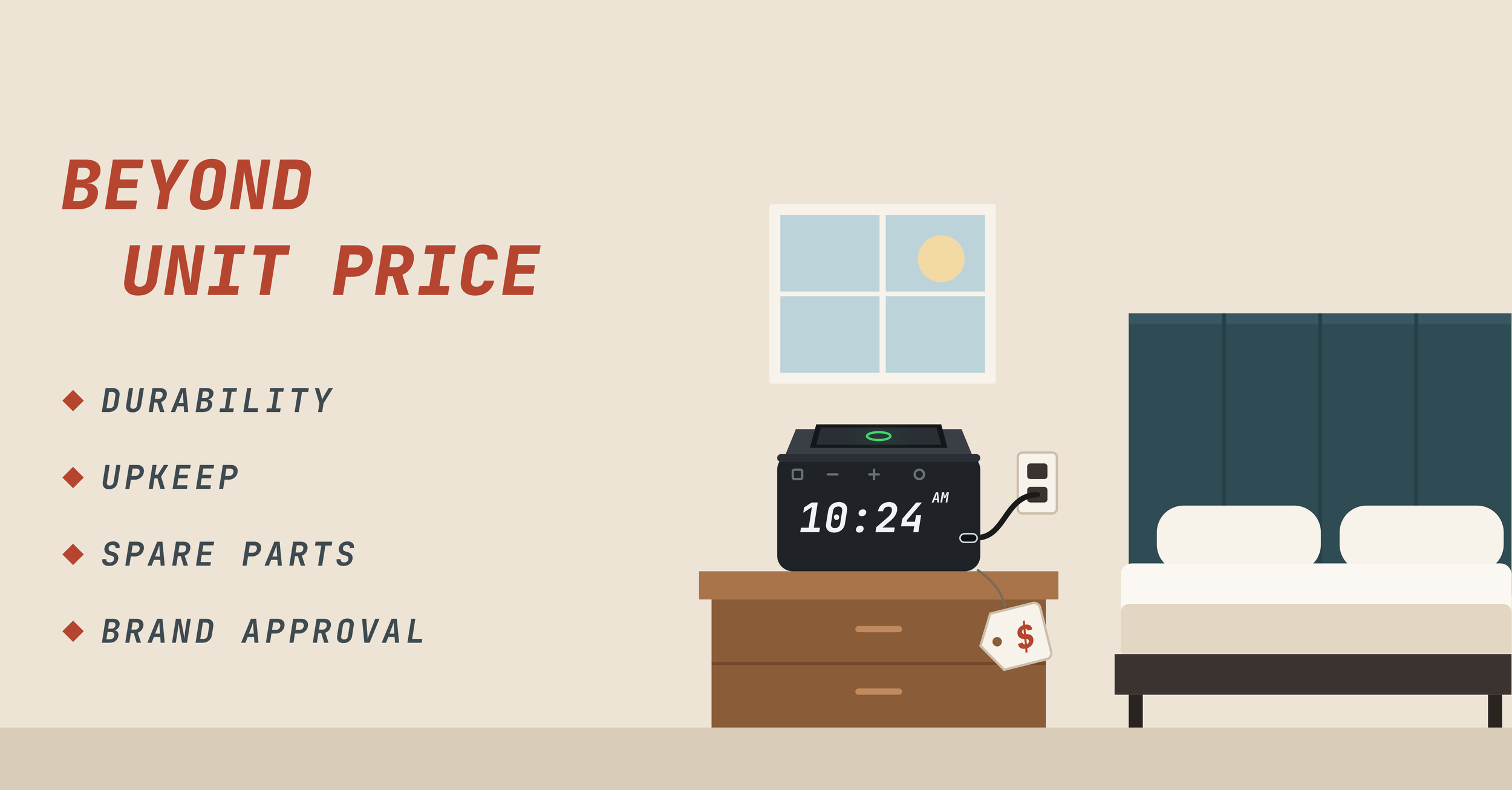
When margins are tight, it's natural to look at the purchase order and pick the lowest number. But in the guestroom, the cheapest bedside charger or alarm clock is rarely the cheapest one to own. A device that costs a few dollars less and fails in year two, can't be repaired, or has to be swapped out when the brand updates its standard ends up costing more: in replacement units, labor, guest complaints and review scores.
Here's a practical way to judge guestroom tech on lifetime cost instead of unit price.
1. Start with durability, because guests aren't gentle
Bedside devices take more abuse than almost anything else in the room. They get knocked off nightstands, yanked by cords, splashed with coffee and unplugged by guests hunting for an outlet. Housekeeping moves them every day to clean.
Questions to ask before you buy:
What is the housing made of, and how has it held up in hotel rooms, not just in testing?
Is it UL certified, and does it have surge and over-current protection?
Are cords and plugs secured or easy for guests to walk off with?
How many years does the manufacturer expect it to stay in service?
A slightly higher price for a unit that survives a full renovation cycle almost always wins.
2. Count the maintenance calls, not just the units
Every time a guest reports a dead charger or a blinking clock, someone from engineering walks to the room. That call costs labor time, and if it happens at 11 p.m., it can also cost you the guest's goodwill.
The biggest drivers of those calls tend to be simple: ports that wear out, clocks that are hard to set, and devices guests don't understand. When you compare products, ask other properties how often they get calls about them. Simple, clearly labeled controls and ports that fit today's phones cut down on "how do I use this?" calls as well as "it's broken" calls.
Built-in power changes the math
For new builds and casegoods replacements, built-in power can take several items off the list at once. Nonstop's Terminal 1, for example, combines USB-C and USB-A charging, two tamper-resistant AC outlets, and optional GlowWell™ lighting and lamp control in one flush-mount panel. Hotel Management noted it can replace up to four separate line items: the outlet module, USB hub, bedside light switch and nightlight. Fewer separate parts means fewer things to buy, install and fix.
3. Ask about replacement parts before you need them
The worst time to find out a product can't be repaired is after 40 rooms have a problem. Before you spec, find out:
Can you order a single replacement unit, or only full cases?
Are replacement cords, adapters or face plates available separately?
Will the same model (or a drop-in match) still be available in three years, so rooms stay consistent?
Does the supplier keep stock in North America, or will you wait on the next production run?
A product that stays in the catalog and in stock protects you from mismatched rooms after the first round of replacements.
4. Brand approval protects your PIP budget
If your hotel is flagged, the product has to meet brand standards, both at opening and at the next property improvement plan. Buying something that isn't approved, or that falls out of compliance when the standard changes, can mean paying for guestroom tech twice.
Ask for proof of approval for your specific brand and check it against the current standard. Nonstop's charging stations and clocks have been approved by Marriott, Hilton, Hyatt, Choice and other leading hotel brands, and Nonstop is an Avendra and HSM approved supplier.
5. Future-proof with USB-C now
The fastest way for bedside tech to become obsolete is for guests' devices to move on without it. USB-C is now the standard: since December 28, 2024, the EU's common charger rules have required USB-C on new phones, tablets and other small devices sold there, and laptops were added on April 28, 2026. Guests everywhere are traveling with USB-C phones and laptops.
Rooms that only have USB-A ports will feel dated sooner, and guests will fill the gap by unplugging lamps to use their own bricks. When you compare products, look at:
The mix of USB-C and USB-A ports (you still need both for a few more years)
Whether wireless charging makes sense for your guests
As one example, Terminal 1 lists two USB-C ports at up to 30W, plus a 12W USB-A port. Plug-in options like Station P combine USB-C, USB-A and Qi wireless charging with AC outlets for rooms where the casegoods are staying.
6. Built for hotels, not just bedrooms
A bedside clock or charger might look similar to something you’d buy for your home, but hotels have very different requirements. Hundreds of guests interact with the same device, housekeeping handles it daily, and engineering teams need it to work without constant attention.
Purpose-built hospitality products address challenges that consumer electronics often overlook:
Automatic daylight saving time adjustments: Clocks that automatically adjust for DST eliminate the need for engineering or housekeeping to reset hundreds of clocks twice a year.
Anti-theft features: Secured power cords and other theft-deterrent designs help prevent devices from disappearing or being unplugged and relocated.
Guest-friendly operation: Intuitive controls, easy-to-read displays, and simplified alarm settings reduce confusion and unnecessary calls to the front desk.
Alarm reliability: Hotel clocks should be designed to minimize the risk of a previous guest’s alarm disturbing the next guest.
Commercial-grade construction: Designed for repeated use, cleaning, and the everyday abuse of a hotel environment.
The financial impact: A feature that saves just two minutes of staff time per room can save more than 16 hours of labor across a 500-room hotel. Multiply that by recurring maintenance events over several years, and small design decisions can make a meaningful difference to operating costs.
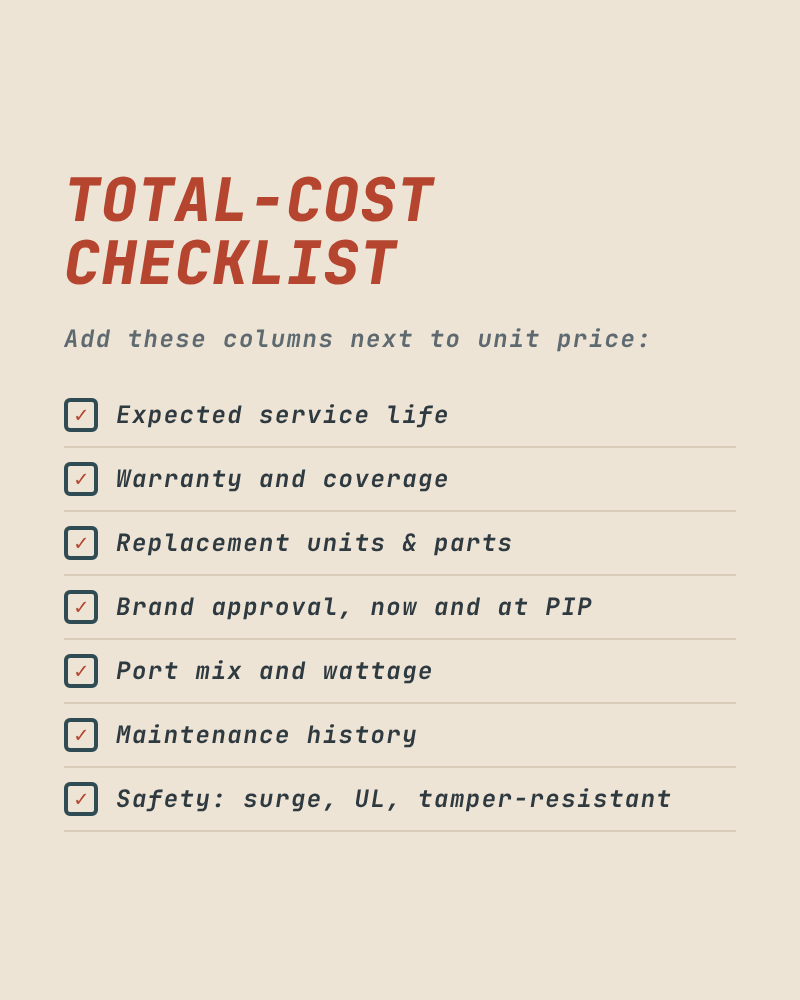
A simple total-cost checklist
When you line up quotes, add these columns next to unit price:
Expected service life in a hotel room
Warranty length and what it covers
Replacement unit and parts availability and lead time
Brand approval status for your flag, today and at your next PIP
Port mix and wattage (USB-C, USB-A, wireless)
Maintenance history from other properties using it
Safety features: surge protection, UL certification, tamper-resistant outlets
Divide the installed cost by the years you expect to keep it, add a realistic estimate of replacements and engineering time, and the "cheap" option often looks a lot less cheap.
See it for yourself
The best way to judge durability and ease of use is to put a unit on a real nightstand. If you're planning a renovation, conversion or new build, request a sample or talk to the Nonstop team about which Station or Terminal 1 configuration fits your rooms:
Sources
Skift, "Hilton CEO Sees More Room to Improve Owner Margins" (Sep 23, 2026): https://skift.com/2026/09/23/hilton-ceo-sees-more-room-to-improve-owner-margins/
Skift, "Hilton Cuts Fees to Rebuild Hotel Owners' Margins as Costs Stay Sticky" (Jul 28, 2026): https://skift.com/2026/07/28/hilton-cuts-fees-to-rebuild-hotel-owners-margins-as-costs-stay-sticky/
Hotel Management, "Nonstop Products launches built-in guestroom power platform": https://www.hotelmanagement.net/tech/nonstop-products-launches-built-guestroom-power-platform
KniTec, Nonstop Terminal 1 product listing (specs): https://knitec.com/products/nonstop-terminal-1-with-built-in-power-lighting-and-usb-c-usb-a-charging-and-surge-protection-for-hotels
European Commission, "EU common charger rules: Power all your devices with a single charger": https://commission.europa.eu/news-and-media/news/eu-common-charger-rules-power-all-your-devices-single-charger-2024-12-28_en
Acroname, "The EU's Universal USB-C Mandate: The April 2026 Laptop Deadline": https://acroname.com/blog/eus-universal-usb-c-mandate-april-2026-laptop-deadline
Nonstop, "Warm Light, Custom Trim, One Terminal" email (Sep 2026) and nonstopproducts.com (brand approvals, Avendra/HSM, Station P)